


Public Investment, Private Windfalls: The NFL Draft as Civic Redistribution Theater

The TribLive story on Pittsburgh’s NFL Draft restaurant traffic [NFL Draft-driven restaurant traffic a tale of haves and have nots] is not surprising. Nor is it unusual. It is the very predictable pattern of publicly subsidized spectacle: the costs are socialized, the benefits are concentrated, with the positive press releases piling up for years before any receipts ever arrive.
The official promise was broad civic uplift. Visit Pittsburgh estimated the draft could bring roughly $120 million to $213 million in economic benefit to the region. But the actual restaurant story looks much less like a rising tide and much more like a funnel. McFadden’s, sitting right near the draft footprint, had lines down North Shore Drive. Burgatory doubled its usual business. Gaucho saw two-hour waits. Meanwhile, just a few blocks or neighborhoods away, restaurants that prepared for a rush were staring at empty tables. Peppi’s stocked up, simplified its menu, added staff, and lost. Hofbrauhaus reported traffic down around 40%. Big Burrito’s (Mad Mex, etc) president says his chef's wondered aloud, “Where are they eating?”
This is the real economy correcting the fantasy economy.
The fantasy says, “Hundreds of thousands of people are coming. Everyone will benefit.”
The real economy says, “Location, access, crowd flow, event security, road (and river) closures, habit, weather, vendor selection, and human laziness matter.”
People do not spread themselves evenly across a city because politicians and a tourism agency made a projection. They eat where they are standing. They drink where the line is tolerable. They stay inside the fenced, branded, curated event universe until they go home. That is not a market failure. That is human action.
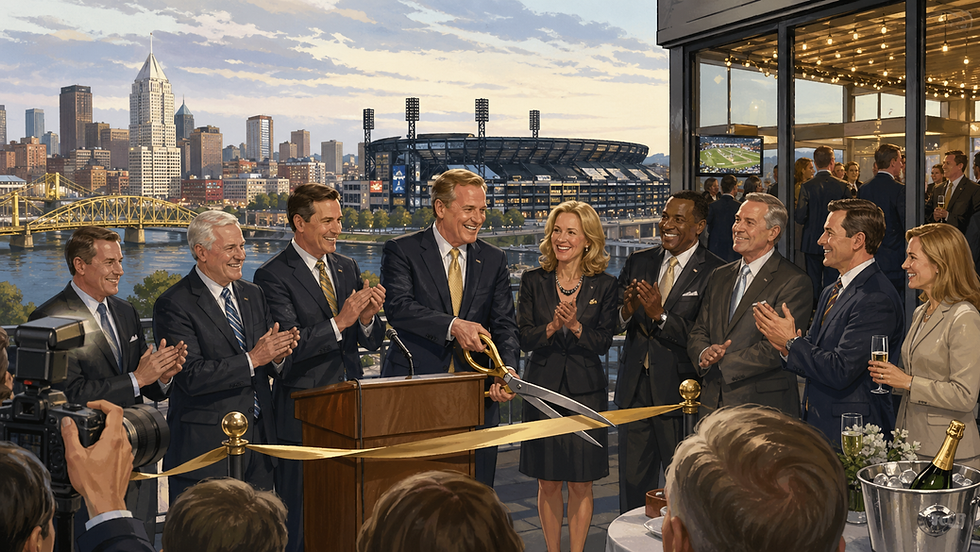
The more damning point is that public money does not follow the same logic as private risk. A restaurant owner who guessed wrong eats the loss. He stocked the food, scheduled the labor, opened the doors, and discovered the crowd was somewhere else. That is painful, but at least it is honest, although very much mislead by grandiose political promises.
The taxpayer gets no such choice. The taxpayer is conscripted into the civic gamble whether he owns a bar beside the stage, a sandwich shop six blocks away, or no business at all. Pennsylvania committed $10 million for site preparation, Visit Pittsburgh marketing, and public safety reimbursements. Allegheny County committed $3 million in hotel tax revenue. Pittsburgh’s mayor had also pledged $1 million in city tax dollars through Visit Pittsburgh, even as city officials questioned the expense amid basic fiscal pressures.
So here is the civic bargain in plain English: everyone helps buy the lottery ticket, but only the businesses closest to the pre-determined winning number get paid.
And Pittsburgh has seen the bigger version of this bargain before.
The NFL Draft is not the same thing as the stadium fights, but it echoes the same political habit. In 1997, voters in Southwestern Pennsylvania rejected the Regional Renaissance Initiative, the proposed sales tax increase widely associated with funding new stadiums and related development. The public said no. Then Plan B emerged, and public money still helped build what became Heinz Field and PNC Park. Hundreds of millions in subsidy for owners of teams worth billions.
That history matters because it reveals the same underlying instinct. When the public resists paying for private sports infrastructure, the political class searches for another mechanism. The justification changes. The funding channels change. The rhetoric gets polished. But the basic pattern remains: taxpayers are asked, pressured, maneuvered, or simply routed into financing projects that disproportionately enrich private beneficiaries.
The teams received publicly supported places of business. Those facilities helped preserve and enhance the value of already valuable private sports franchises. The public received civic pride, skyline aesthetics, traffic patterns, tax obligations, and a permanent reminder that “no” is not always treated as an answer when enough politically connected interests want “yes.”
The draft is the weekend version of that same logic. Not identical in scale, but familiar in structure.
The NFL gets a national branded event. Politicians get cameras. Tourism officials get their economic impact projections. A handful of businesses closest to the action get a genuine windfall. Meanwhile, taxpayers cover public costs, regular businesses gamble on unreliable hype, and residents are expected to treat disruption as the price of civic relevance.
For die-hard NFL and Steelers fans, the draft may feel like a civic holiday. Fair enough. But most all taxpayers are not draftniks, let alone diehard football fans. And even most serious football fans are perfectly content to care about football only when the preseason arrives, and then fully once regular season games are actually played. The draft? Read about it in the sports section in days after its done. After all, most drafted players wont be seen with the team until NFL team camps kick off in July.
For everyone else, the arrangement is impossible to justify: they subsidize a three-day talent lottery where most names gushed over by the NFL PR hype-machine will never make it in the league, ending up as near-irrelevant footnotes buried in each team's history.
This is why the phrase “public investment” deserves suspicion. In private life, investment means risking your own capital for an uncertain return. In government life, “investment” often means risking other people’s money for benefits that can be claimed politically even when they are concentrated privately.

If the event succeeds, politicians point to the crowd. If the benefits are uneven, they call it economic impact. If some businesses lose money, that is unfortunate. If taxpayers lose money, that is invisible. If the city never recoups the cost, the loss dissolves into the already broken budget, a rounding error nobody in government is paid to care about. In other words, nobody responsible for making the actual investment suffers for "investment" losses. Instead, the political class quickly pivots to the next great private-public scheme.
Rinse. Repeat.
In closing, the Trib | Live article's lesson is not that no restaurants benefited. Some clearly did. The lesson is that selective benefit is being sold as public benefit.
That is the recurring anatomy of subsidized spectacle:
The benefits are visible.
The costs are scattered.
The winners are photographed.
The losers are anecdotal.
The taxpayers funnel the economy to political beneficiaries.
libertarians are all for wonderful professional sports and great events. What we're not for is political elites having the power to reach into the pocketbooks of everyone else, those who otherwise have no interest in such events and functionally stealing their wealth, and directing it for the political class's own agendas.
If the political class believes these events are of such great ideas and of such benefit, they should simply use their own dollars and invest them directly. Their risk. Their return. Their profits. Their losses.
Leave the rest of us out of it.


Comments